Entity Understanding and Resolution System
Abstract
Technologies for machine learning-based entity understanding and resolution are disclosed. Data for training an entity resolution model is collected to learn semantic relationships associated with entity names. The entity names are provided in a domain of documents that follow semantic conventions differently from natural language semantic conventions. The data includes entries each specifying an entity name and a label. The entity resolution model is trained using the data to learn and generalize the semantic relationships and is deployed to serve requests for resolving an entity name from text extract from a document image.
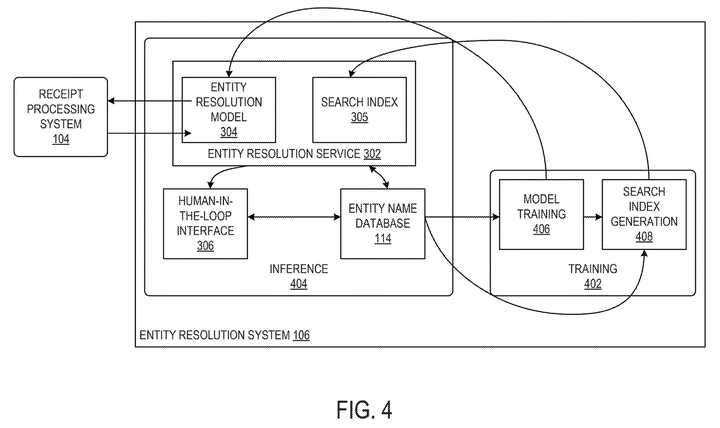
Conventional entity resolution models, including pretrained sentence transformers, are trained on natural language and struggle with domains like retail receipts, where text is abbreviated, visually structured, and prone to OCR errors. The system disclosed here instead trains a model directly on domain-specific data (e.g., canonical retailer names and their known variants) so it learns the semantic relationships particular to that domain, builds a fast approximate-nearest-neighbor search index over the learned embeddings, and pairs the model with a human-in-the-loop interface so an evaluator can confirm or correct outputs and continuously refine the model over time.